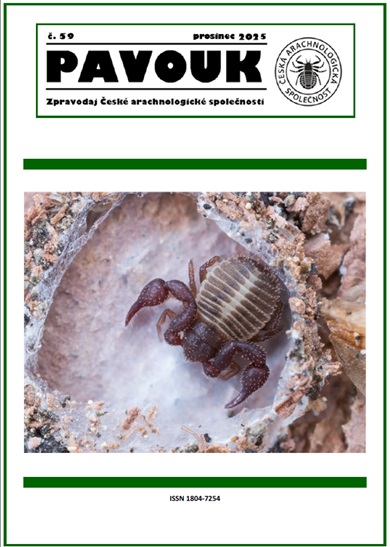
Pavouk 59 (12/2025) 2025
- Autoři
- Anděla Šimečková, RNDr. Antonín Kůrka, Mgr. Antonín Roušar, Mgr. Eva Líznarová, Ph.D., Mgr. Ivana Hradská, Mgr. Jan Dolanský, MUDr. Kryštof Rückl, RNDr. Milan Řezáč, Ph.D., Mgr. Ondřej Machač, Ph.D., Pavel Bezděčka, Pavel Krásenský, Peter Gajdoš, RNDr. Petr Dolejš, Ph.D., Petr Veselý, RNDr. Vlastimil Růžička, CSc.
- Abstrakt
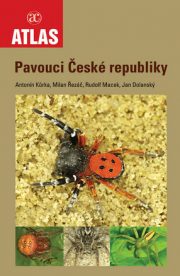
Pavouci České republiky; Taxonomické změny; Víme, koho máme ve znaku ČASu?; Panamomops szinetari (Araneae: Linyphiidae), nový druh pro Česko a Slovensko; panonský stepní relikt, expandující teplomilný prvek, nebo zavlečený invazivní druh?; Významné faunistické nálezy pavouků na mokřadech Jižní Moravy; Přehlížená domácí plachetnatka; Pholcus alticeps Spassky, 1932 v Krušných horách. Po druhé…; Výskyt pavučenky Erigone dentosa (Araneae: Linyphiidae) v Krušných horách; Nová lokalita sekáče Nemastoma bidentatum sparsum (Opiliones: Nemastomatidae) v ČR; Zajímavé nálezy sekáčů aneb jak občanská věda pomáhá našim opilionologům, část druhá; Čekání na odlet; European Congress of Arachnology – Zadar 2025; Novodobé určovací semináře; Česká bibliografie; Nové knihy
Panamomops szinetari (Araneae: Linyphiidae), nový druh pro Česko a Slovensko; panonský stepní relikt, expandující teplomilný prvek, nebo zavlečený invazivní druh? Panamomops szinetari (Araneae: Linyphiidae), a new species for Czechia and Slovakia; a Pannonian steppe relict, an expanding thermophilic element, or an introduced invasive species? Pavouk 59: 5–10 (in Czech, English abstract) 2025
- Autoři
- RNDr. Milan Řezáč, Ph.D., Peter Gajdoš, Petr Veselý, RNDr. Vlastimil Růžička, CSc.
- Abstrakt
- Panamomops szinetari (Araneae: Linyphiidae), a new species for Czechia and Slovakia; a Pannonian steppe relict, an expanding thermophilic element, or an introduced invasive species? The paper reports on the occurrence of the newly described species Panamomops szinetari (Gallé-Szpisjak & Gallé, 2025) in Czechia and Slovakia. The species was previously known only from eastern Hungary. New localities are found in southeastern Czechia and southern Slovakia, on the northern edge of the Pannonian region. It was caught using pitfal traps on the soil surface and pipe traps inside the soil. It was found in steppe grasslands, salt marshes, meadows, and a highway cutting. The species is bound to grasslands and also penetrates cracks in the soil. However, it is also capable of colonizing secondary habitats. It is unlikely that this is a relict species that would have escaped the attention of two hundred years of intensive arachnological research in central Europe. It has appeared in three central European countries within just six years (2015 in Hungary, 2019 in Slovakia and 2021 in Czechia* – Figs 1–7). 5rane were a species undergoing gradual northward expansion due to climate warming, for example, this would have explained the new findings in Slovakia and Moravia, but not the many years of oversight in Hungary. Therefore, it cannot be ruled out that this is in fact an introduced species that prefers natural steppe communities, where it has been spreading over the last ten years. If this were the case, 5raneae, we do not know its true geographical origin.
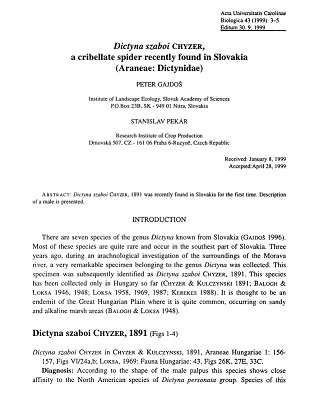
Dictyna szaboi Chyzer, a cribellate spider recently found in Slovakia (Araneae: Dictynidae) 1999
- Autoři
- Peter Gajdoš, prof. Mgr. Stanislav Pekár, Ph.D.
- Abstrakt
- Dictyna szaboi Chyzer, 1891 was recently found in Slovakia for the first time. Description of a male is presente.


Online atlas
Česká arachnologická společnost
Pavouci
Sekáči
Štírci
Pavouci České republiky